
 NL
NLStart from the problem. Build from the people.
Every engagement starts with an honest look at what is actually happening and what a successful outcome looks like. From there, we draw on a broad range of operational, organisational and leadership approaches, including four proprietary building blocks developed specifically for leaders in high-hazard industries.
Standardise the core. Adapt the application.
Before anything is recommended, the full situation needs to be understood. That means listening before proposing, and agreeing on outcomes before choosing methods.
Step 1
Understand the situation
Conversations across levels and functions. Time on site, not just in meeting rooms. A clear picture of where alignment is breaking down and why.
Step 2
Agree on outcomes
What does a successful result look like in practice? Not in general terms, but specifically, and from the perspective of the people who will live with the change.
Step 3
Choose the right approach
Draw from the best available methods for the situation, including proprietary building blocks where they fit, without forcing a framework onto a problem it wasn't built for.
Step 4
Build and exit deliberately
Every engagement is designed with a clear end point. The goal is capability the organisation sustains independently, not a dependency on external support.
Human-centric leadership at the core
People are not the risk to be managed. They are the solution waiting to be heard. Every method used here starts from that conviction. Leadership behaviour, not only systems and procedures, is what determines whether people work safely and well.
Across the whole organisation, not one department
Safety and operational performance are not the responsibility of the EHS function alone. This work engages the people who actually shape performance every day: operational leaders, frontline teams, support functions, and often contractors and other external stakeholders who carry real risk.
Practical and grounded in operational reality
The methods combine proven frameworks and signature topics with extensive operational and executive experience in high-hazard industries. The core remains consistent; the time, depth, format, audience language, examples and exercises are adapted to the situation.
Independent of any single methodology
Be Human Be Safe draws on a broad toolkit. Proprietary building blocks sit alongside established change management, organisational psychology, systems thinking and coaching approaches. The right tool is chosen for the situation, not the other way around.
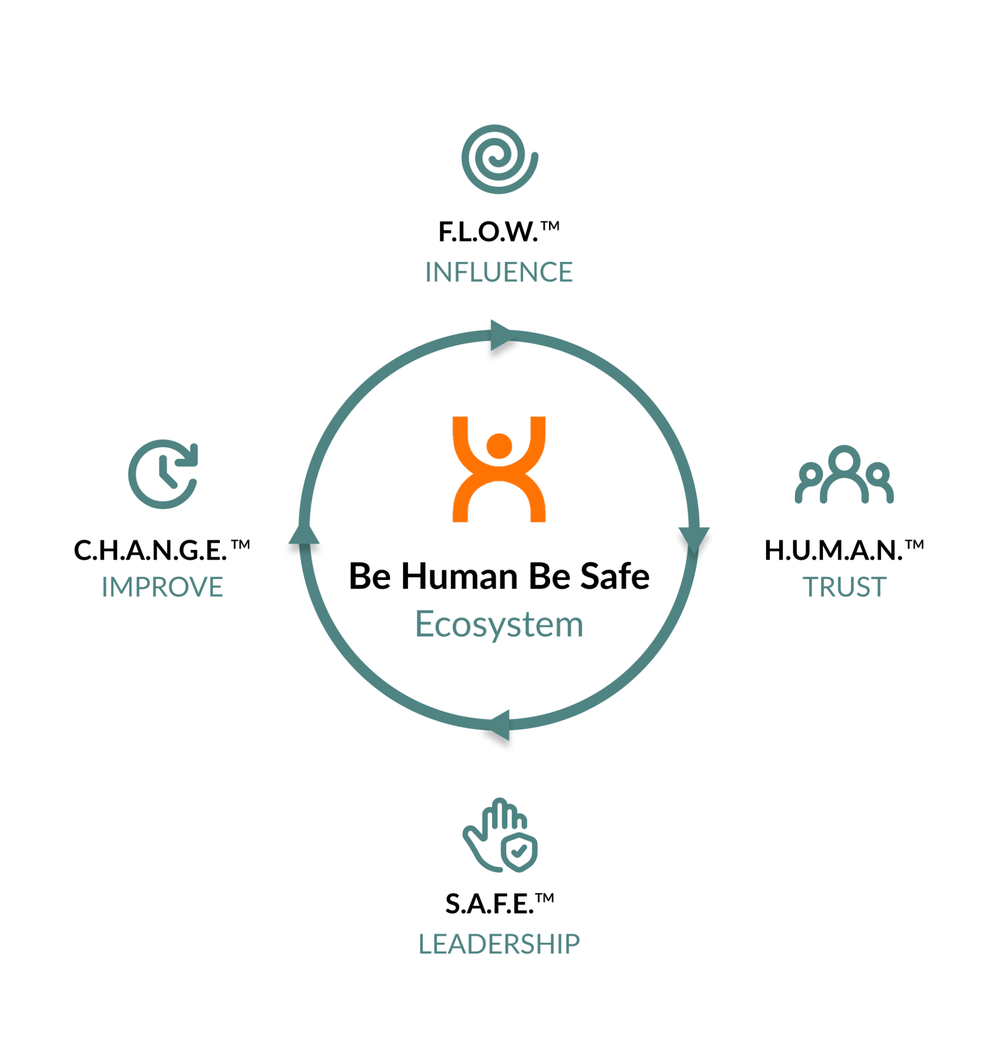
Four building blocks. One connected system.
Four practical models address recurring challenges in influence, safety leadership, human performance and sustainable change. Each can be used independently or combined within a wider intervention. The starting point is always the problem that needs to move, not the model itself.
F.L.O.W.™ strengthens influence. H.U.M.A.N.™ improves how organisations understand people and work. S.A.F.E.™ develops visible leadership behaviour. C.H.A.N.G.E.™ helps new ways of working take root.
Developed from direct operational and executive experience in high-hazard industries, the models provide structure without forcing a standard solution onto every situation.
The four building blocks as a living system
Explore each building block

F.L.O.W.™
Turn expertise into organisational action
Important proposals can be built on strong analysis and still fail to move. F.L.O.W.™ helps leaders frame the context, link the case to the drivers decision-makers weigh, optimise the message and work the relationship needed to turn expertise into organisational action.
- F Frame the context
- L Link to drivers
- O Optimise the message
- W Work the relationship

H.U.M.A.N.™
Shift from compliance to genuine care
H.U.M.A.N.™ is the Be Human Be Safe response-and-learning framework for how leaders and organisations handle error, uncertainty and unwelcome information.
- H Hold your judgement
- U Understand the context
- M Make learning possible
- A Apply error tolerance
- N Normalise honest conversations

S.A.F.E.™
Develop leaders who move people forward
The leaders who influence safety and operational performance most are often the least supported in developing that influence. S.A.F.E.™ builds the presence, courage and consistency that allow leaders to engage authentically, hold others accountable and create an environment where people take real responsibility.
- S Speak with clarity
- A Act with consistency
- F Foster accountability
- E Engage authentically

C.H.A.N.G.E.™
Make change stick for the long term
Most change stalls when external support leaves. C.H.A.N.G.E.™ embeds new behaviours into daily operations, builds internal champions who sustain momentum and creates the visible evidence of progress that keeps the work moving independently. The capability stays with the organisation.
- C Case for change
- H Harness leadership
- A Activate champions
- N Normalize practice
- G Grow capability
- E Embed evidence
Free resources to explore the approach.
Each guide is a practical introduction to one of the building blocks and can be applied immediately.
Guide · F.L.O.W.™
Design your influence as a safety or EHS leader
A practical guide to turning technically sound proposals into decisions that actually happen. For safety and operational leaders who know what needs to change but cannot get it heard.
Guide · C.H.A.N.G.E.™
Lead change that survives beyond the programme
Six elements for embedding change in high-hazard organisations. Built for leaders who are tired of initiatives that launch well and fade without trace.
Get the guide →Development · Individual leaders
Open programmes and coaching for safety and operational leaders
For leaders who want to develop their influence, judgement and implementation capability without waiting for an organisational programme to reach them.
Explore development →The right starting point depends on your situation.
A first conversation is the best way to find it. We use proven frameworks where they fit and adapt their application to the challenge, audience and operational context.
Start a conversation